


TL;DR (updated May 20, 2029
- Enemy-based positioning names the obstacle your reader is already fighting, not the reader themselves.
- Vague expert positioning ("clear, evidence-based, inclusive") fails because audiences feel problems, not adjectives.
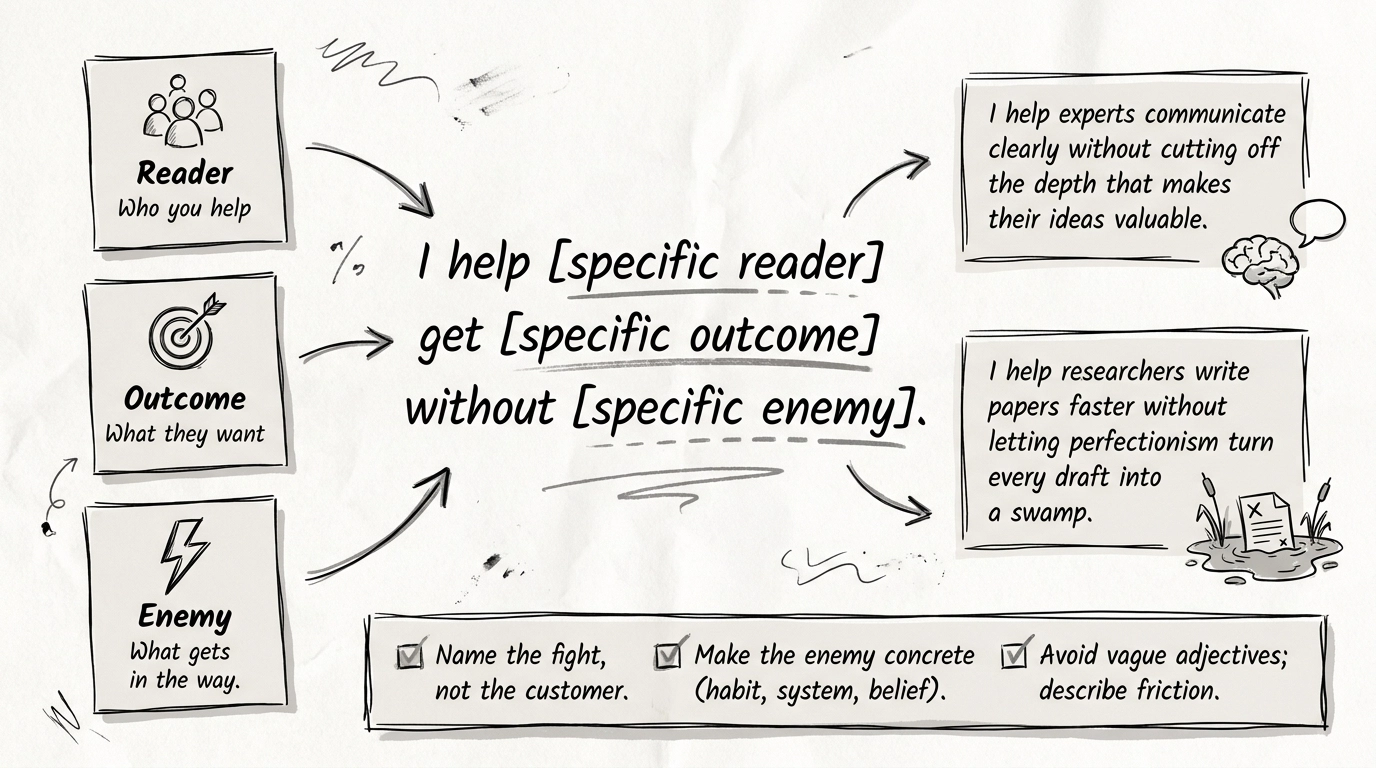
- The formula: I help [specific reader] get [specific outcome] without [specific enemy].
- A good enemy is a habit, system, environment, or false belief → never a person.
- Positioning theorists April Dunford and Donald Miller both argue conflict drives recall.
What Is Enemy-Based Positioning?
Enemy-based positioning is a copywriting and brand-strategy method where an expert defines themselves by the obstacle they oppose (e.g., a habit, system, environment, or false belief) rather than by credentials or features. It earns attention because readers recognize the friction immediately, then engage with the expert's nuance.
I started last Friday’s Authority Lab hot seat with the least heroic opening possible.
“Hello everyone, or no one yet.”
Then I sat there for a short minute, waiting to see if anyone would show up.
I wondered if I should have sent an announcement. I wondered if the time was wrong. I wondered if Friday was a bad idea. Very strategic founder behaviour. Sitting alone in a video call, questioning my calendar choices.
Then many people joined. Phew. Awkward minute over.
And the session turned into one of the clearest conversations we’ve had in the Authority Lab so far.
The format was so simple. People brought their positioning statements that I helped them formulate over the last month. The classic “I help X do Y without Z” kind of thing.
I expected us to clean up at least the language, but I had a bigger plan: Confrontation.
So, we found the missing fight.
What is positioning, and why do most expert statements fail?
Positioning is the deliberate choice of which problem you solve, for whom, and against what alternative, a definition popularized by April Dunford in Obviously Awesome (2019).
Experts love accurate language. I do.
And this all sounds good until you watch it turn into pudding.
Most expert positioning fails because it stacks careful adjectives ("timely, relevant, inclusive") that are technically correct but emotionally invisible. Readers feel problems.
"Safe language is the pot belly of positioning: accurate, comfortable, and useless in public."
None of this language is wrong. That’s the problem.
It's too safe to be useful in public.
Your audience does not feel a pair of careful adjectives. They feel a problem. They feel the thing in their way.
- They feel the athlete who performs beautifully in practice and freezes in competition.
- They feel the meeting where nobody understands the local context.
- They feel the student who wants the grade more than the learning.
Your public positioning gets 100% better when it names that friction. Even better, it names what causes the friction.
That’s the enemy.
Impact needs an enemy.
Your customer is not the enemy
The word enemy makes thoughtful experts nervous. I get that.
Most of the people I work with do not want to bash anyone. They do not want to flatten complex problems into cheap conflict. They do not want to become LinkedIn theatre people yelling about how everyone else is stupid.
Good.
Please keep that instinct.
The trick is to aim the fire at the obstacle, not the person.
→ Your reader is the person stuck in the fight.
→ Your customer is not lazy. The enemy might be inertia.
→ Your client is not ignorant. The enemy might be the technical gap that makes a good decision feel risky.
You become useful when you name the thing they are already fighting.
It makes all the difference.
If you make your customer the villain, they will defend themselves. If you make their obstacle the villain, they will lean in.
They’ll finally feel seen.
Who is the enemy in enemy-based positioning?
The enemy is the obstacle blocking your reader's outcome. Donald Miller's Building a StoryBrand (2017) frames this as the villain in the customer's hero journey. Valid enemies include habits (perfectionism), systems (assessment-driven schooling), environments (algorithmic feeds), and false beliefs (nuance = trust):
- A habit: Saving habits that drain money, writing habits that keep smart people polishing the first paragraph for three weeks, research habits that make every new project start from zero.
- A system: Assessment systems that reward performance over learning, academic systems that ask for public impact while punishing anyone who writes in public, corporate systems that turn clear thinking into slide sludge.
- An environment: The 9-to-5 treadmill, the inbox, meeting culture, the algorithmic casino pretending to be professional networking.
- A false belief: “If I am more nuanced, people will trust me.” “If the work is good, the right people will find it.” “If I use AI, my voice will disappear.” “If I take a public stance, I will lose my intellectual integrity.”
These enemies work because you already feel them and your audience does, too. You’re naming the conflict that has been running in the background.
The moment it clicked
One Authority Lab member works with athletes.
His first framing was about performance pressure. Athletes train well, then score lower in competition. The obvious solution was mental training.
Useful, but still a little broad.
So we kept digging.
The enemy was the inner voice. The self-talk. The fear of losing. The fear of winning and then having to keep winning. The tiny internal commentator that turns a competition into a referendum on your entire identity.
Now the positioning had heat. Spicy. I loved it.
He could stand against that voice.
Another member teaches pre-service teachers.
Her first framing was full of strong ideas: Creativity, process-based learning, risk-taking, student engagement, meaning-making.
All good.
Still too clean.
Then she named the thing she stands against it all: Shallow learning.
The grading system. The product-based logic. The classroom habit where students learn to ask, “How do I get the A?” before they ask what the work is trying to teach them.
That is a real enemy. Boom.
Everyone who has been through school recognizes it immediately.
Even AI fits this story. AI did not create shallow learning. It accelerates the shallow learning already built into the system.
Now, she had a sticky point of view.
One member works with literary scholars.
Her challenge was different. She resisted the customer language, which made sense. In scholarship, people do not always think in terms of markets and solutions. They think in terms of knowledge, methods, traditions, and ways of seeing.
So we stayed with that.
The enemy became institutional sameness. The Eurocentric lens. The habit of talking about diversity while keeping the same old epistemological frame.
That’s strong.
It gives her public access into deep work without making the work shallow.
You know, this is the piece that many experts are afraid to admit.
An enemy does not reduce your nuance.
It earns attention long enough for your nuance to matter.
A simple positioning test
Most expert writing fails because it always starts with the answer.
Here is my
- framework
- method
- service
- research
The reader has no reason to care yet.
They don’t know what fight you’re entering. They have to learn about what problem you’re refusing to tolerate. They must be convinced why your sentence should interrupt their day.
Friction creates this hook.
This is true in stories. A good story needs pressure. Something has to be at stake. A character wants something, and something blocks them.
Public authority works the same way.
You want to be known for something. Your audience wants a result. The enemy blocks the result. Your position becomes the stance you take against that enemy.
That is where attention starts.
Forget your list of credentials.
Move past your polished bio.
Don’t write another sentence that sounds like it survived three committee reviews and a light afternoon nap.
It starts with a fight.
Take your current positioning sentence. Find the outcome. Then find the obstacle.
Most people stop too early. A little less Mr. Spock, a little more Captain Kirk.
They write:
→ I help experts communicate their ideas more clearly.
Fine. Clear enough. Also forgettable.
Now add your enemy:
→ I help experts communicate their ideas clearly without cutting off the depth that made those ideas valuable in the first place.
Better.
The sentence now has friction. It names the fear many of your carry: That visibility will make you shallow. And, yes, that’s how I position myself.
Here is another:
→ I help researchers write papers faster.
Useful. Flat.
Add the enemy:
→ I help researchers write papers faster without letting perfectionism turn every draft into a swamp.
That’s what I have done for years now. Now, the reader can feel it.
They know that swamp.
They’ve lived in that swamp.
They’ve probably decorated it like Shrek.
The formula is quick and simple:
I help [specific reader] get [specific outcome] without [specific enemy].
The without part is where the positioning gets serious.
BTW: I created a quiz that lets you check your current positioning.
How do I find my enemy? (A 3-step positioning test)
Take your current positioning sentence, isolate the outcome, then name what blocks that outcome for 80% of your audience. According to Nielsen Norman Group research on landing-page comprehension, users decide relevance in under 10 seconds, which means the obstacle must appear in the first sentence.
Why does naming an enemy increase attention without reducing nuance?
Conflict is the oldest attention mechanism in narrative. Harvard Business Review's analysis of B2B messaging found that contrast-driven value propositions outperform feature lists in recall tests. Naming an enemy front-loads contrast, so that your nuance then has somewhere to land.
"An enemy does not reduce your nuance but it earns attention long enough for your nuance to matter."
If your positioning feels vague, you probably do not need more adjectives.
You need a sharper enemy.
Name the habit, system, environment, activity, or false belief that blocks your reader from the result they want.
How is this different from negative or attack marketing?
Enemy-based positioning focuses on obstacles. The customer is the hero and the enemy is the friction. Attack marketing names competitors or shames audiences, a tactic the FTC notes can violate truthful-advertising standards. Enemy-based positioning stays empathetic to the reader while being smart about the system.
Keep your empathy for the person.
Aim your fire at the obstacle.
That is how your writing gets clearer.
That is how your hooks get stronger.
That is how your authority starts to feel like a point of view instead of a professional summary.
I am opening the waitlist for a free Authority Lab Mastermind called How to create hooks for your writing.
We will take this exact idea and turn it into a practical hook system.
Bring the topic you keep circling. Bring the sentence that feels too soft. Bring the idea that deserves more attention than it is getting.
We will find the fight hiding inside it.
FAQ
Q: What is enemy-based positioning in one sentence?
It is positioning that defines an expert by the obstacle they oppose, not the features they offer.
Q: Can my enemy be a competitor?
Generally no. Effective enemies are habits, systems, environments, or false beliefs that your audience already feels, competitors invite legal and reputational risk.
Q: How do I know if my enemy is specific enough?
A stranger in your target audience should nod within 10 seconds. If they ask what you mean, the enemy is still abstract to them.
Q: Does this work for academics or scholars?
Yes. Scholars can position against institutional sameness, methodological orthodoxy, or epistemic flattening, all without market language.
Q: Won't naming an enemy make me look polarizing?
Only if you target people. Targeting an obstacle increases recall while preserving credibility, consistent with StoryBrand research.
Q: What is the positioning formula?
I help [specific reader] get [specific outcome] without [specific enemy].
Q: How often should I revisit my positioning?
At least every 6–12 months, or whenever your audience changes. Dunford recommends re-testing whenever win rates drop.


