


In 2021, Katalin Karikó’s research saved the world.
Yet, I bet you’ve never heard of her.
In 1995, the University of Pennsylvania gave Dr. Katalin Karikó a simple choice. She could leave, or accept a demotion. She had spent six years as a research faculty member in the School of Medicine, working on messenger RNA, a molecule she believed could teach human cells to produce their own therapeutic proteins. She had the science. She had the conviction. She did not have the grants.
Karikó chose the demotion. She took the pay cut. She kept working.
For the next decade and a half, she operated at the margins of an institution that had decided she was a dead end. Grant applications came back rejected, one after another. Colleagues saw her research as too complex, too speculative, too far from anything that would produce fundable results within a standard grant cycle. She was, by multiple accounts, called “the crazy mRNA lady.” At one point she didn’t have her own lab space. She relied on the goodwill of senior colleagues to stay employed at all.
The science she was building during those years of institutional exile, solving how to get synthetic mRNA into human cells without triggering a lethal immune response, would become the foundation of the Pfizer-BioNTech and Moderna COVID-19 vaccines. The work that UPenn considered unfundable would eventually earn her the 2023 Nobel Prize in Physiology or Medicine.
But that vindication was decades away. In the late 1990s and 2000s, the only thing Karikó’s career demonstrated to the outside world was that having the right answer, delivered without the right packaging, gets you demoted. The world was never fair.
While Karikó was struggling to keep a lab bench at Penn, Elizabeth Holmes was building Theranos into a $10 billion company on science that really did not work.
Holmes founded Theranos in 2003 at age 19, claiming she had developed a device that could run hundreds of diagnostic blood tests from a single drop of blood. The technology was, by every subsequent investigation, fraudulent. It physically did not function. ‘Fake it til you make it’ taken to the extreme. When investors or board members pressed for engineering specifics, Holmes invoked trade secrets. When regulators started asking questions, she lawyered up.
She raised approximately $724 million from private investors. With hot air.
Holmes did not sell data. She sold a narrative. A compelling idea. She spoke publicly about her fear of needles, connecting her company’s mission to a childhood emotion that every listener could feel. She wore a black turtleneck in conscious imitation of Steve Jobs, borrowing the visual language of a tech visionary. She deepened her voice in interviews and presentations, a deliberate status signal that multiple former employees have confirmed.
The result of all of this was that Holmes appeared on the covers of Fortune and Forbes. The Obama administration named her a Presidential Ambassador for Global Entrepreneurship. Her board of directors included Henry Kissinger and George Shultz (both former Secretaries of State), Jim Mattis (later Secretary of Defense), two former U.S. senators, and a retired Navy admiral. If your advisory board looks like a season finale of House of Cards, someone should be asking harder questions about the dumb blood-testing machine.
The contrast between these two careers is the most expensive case study in modern biotech for what happens when institutions cannot tell the difference between confidence and competence. Markets fund stories, not solutions. Karikó had the data, the decades of work, the actual scientific answer. But heck, she was ignored because everything about her delivery, her grant writing, her institutional status, her presentation style, signalled the struggling academic. Holmes had nothing that worked. She was celebrated because everything about her delivery signalled that she was a Silicon Valley genius. Somewhere out there, a grant reviewer with a stack of Karikó’s applications was probably super impressed by Holmes’s pitch deck. Peer review at its finest.
One of them saved millions of lives and won the Nobel Prize. The other is serving an eleven-and-a-quarter-year federal prison sentence for fraud.
This is the sad reality facing every expert who has spent years building deep knowledge that the right people still haven’t noticed.
Why your brain was never listening to your data
In 1994, a neuroscientist named Antonio Damasio published a book that quietly rewrote our understanding of how humans make decisions. The book was called Descartes’ Error, and its core argument was that emotion is not the enemy of reason. Emotion opens the door to reason.
Damasio had been studying patients with damage to the ventromedial prefrontal cortex, the brain region that connects emotional processing to decision-making. These patients could analyze options with perfect logical clarity. They could list pros and cons. They could evaluate evidence. What they couldn’t do was choose. Without the emotional weighting system that the rest of us take for granted, they were paralyzed by their own rationality.
Damasio called this the somatic marker hypothesis. The idea behind this is that your brain tags experiences with emotional markers (gut feelings, essentially) and those markers become the shortcuts your limbic system uses to make decisions before your neocortex even finishes processing the data. You don’t decide to trust someone and then feel comfortable. You feel comfortable, and then your conscious mind constructs a rationale for why. Serious brains. Silly wiring.
Read that again, McFeely.
This is not pop psychology. This is the architecture of our own human cognition. Every investor who decides to fund a project, every executive who greenlights a budget, every grant reviewer who scores a proposal is running the same flawed neural sequence. Emotion first, justification second. The neocortex thinks it’s in charge. But the limbic system votes before you reason. Your prefrontal cortex is basically the person who joins a Teams call 10 minutes late, stays on mute, and then says, “Sorry, can you repeat that?” The whole room waits with the dead-eyed patience usually reserved for printers and airport kiosks.
And this explains exactly what happened to Katalin Karikó over 30 years of underfunding. Her grant applications were speaking to the neocortex, the analytical brain, the part that evaluates evidence and weighs probabilities. Elizabeth Holmes’s pitch was speaking to the limbic system, the part that actually initiates decisions. Karikó was trying to convince review boards with data. Holmes was making investors feel something first. A childhood fear of needles. A turtleneck that whispered Steve Jobs. A voice pitched low enough to signal control. Each of those details created a somatic marker in every person in the room. When the (non-existent) data came afterward, the brain already understood what to do with that.
I’ve made my own version of this mistake so many times I’ve lost count. Fifteen years in academia. Publications. Citations. Conference presentations. Tenure. A cool research lab. All the credentials that were supposed to signal competence. And for years, I operated under one assumption only. If I just kept producing better work, the right people would eventually notice. And fame and fortune might follow. The meritocracy trap. The belief that excellence is self-evident. It’s like expecting your Hogwarts acceptance letter to arrive by owl post when you haven’t checked the mailbox. The letter might exist. There is no Hedwig delivering it for you.
Now I know that what I assumed was a visibility problem was a connection problem. I was broadcasting data. I wasn’t telling stories. The expertise was real. The communication strategy was broken.
The irony still stings. I had spent years studying human-computer interaction, understanding how people process information, how games shape behaviour, how cognitive load determines whether someone engages or tunes out. I had the theoretical framework to understand exactly why my own communication was failing. I just never thought to apply it to myself. Busted.
Don’t mistake your credentials for connection
You’ve felt this. You’re in a meeting, and you know more about the topic than anyone else at the table. You have the data. You have the experience. You open your mouth, and you lead with your strongest evidence. Fifteen minutes later, someone with half your expertise tells a two-minute anecdote, and the room perks up like Miss Piggy. Suddenly everyone’s nodding. The conversation pivots around their point, not yours. You sit there wondering what just happened. Maybe you’re a little pissed. I know I would be.
What happened is that they gave the room an emotion, and you gave the room receipts. The limbic system won. It wins every time. Emotion is the gateway through which evidence enters into our mind. At the end of the day, we’re just fancy next-gen apes in suits or skirts. Without that gateway wide open, the best data in the world stays on a slide that nobody acts on.
In 1966, psychologist Elliot Aronson at the University of Minnesota published a study in Psychonomic Science that should be required reading for every expert wondering why their credibility doesn’t land. Participants listened to a recording of a person answering quiz questions. The person got 92% right. In one version, the person then knocked over a cup of coffee on themselves. Clumsy. Human. Imperfect.
The clumsy expert was rated as significantly more likeable than the flawless one. Aronson called it the pratfall effect. A highly competent person who reveals a visible human moment becomes more attractive to others. The stumble signals something the polished performance can’t do. It shows us that this person is real. (The effect only works for high-competence individuals though. When an average performer spills the coffee, they just look incompetent. You need the credentials first. Then you’re allowed to mess up in public.) This is the academic equivalent of wearing a wrinkled shirt to your keynote. On purpose. It only works if you’re the keynote speaker. If you’re the technician, people just think you slept in your car. Sorry, Mark.
In 2005, Target rolled out a completely redesigned prescription bottle called ClearRx. The system came from Deborah Adler, a graphic design student at the School of Visual Arts in New York. It started with her grandmother.
Helen Adler had accidentally taken her grandfather Herman’s medication. The pharmacy had condensed both their names to “H. Adler” on identical amber bottles with tiny text. Same last name, same first initial, same container. Helen couldn’t tell them apart.
The pharmaceutical industry knew medication errors were a massive problem. They had decades of data. Pharmacists, doctors, regulators, all of them understood the numbers. And all of them kept designing labels for compliance. They crammed the legally required text onto a cylinder that rolled off the counter and into the junk drawer. They had the equivalent of a 40-slide deck of adverse-event statistics and FDA requirements. Forty slides. In landscape orientation. With a font size that qualifies as a HIPAA violation against your eyeballs. None of it fixed Helen’s kitchen table.
For her thesis project, called SafeRx, Adler started with what she’d seen in her grandparents’ home. Two identical bottles that could kill someone. That’s a real design flaw. She redesigned the bottle from scratch. Flat-sided so it wouldn’t roll. Colour-coded rings so each family member’s prescriptions were instantly distinguishable (red for Helen, blue for Herman). The drug name printed on top of the cap, visible in a drawer. An information card tucked behind the label instead of stapled to a bag nobody reads.
Target’s creative team discovered Adler’s work and adopted it across every in-store pharmacy in the country. The ClearRx bottle entered the permanent collection at the Museum of Modern Art. Adler hadn’t discovered a single new fact about medication errors. Every pharmacist in the country already had the data. She told the story of one grandmother’s kitchen table, and an entire industry’s approach to prescription packaging changed around it.
Steve Jobs understood the same principle. When Apple launched the iPod, the engineering team had spec sheets full of storage capacity, transfer speeds, and codec support. Until then, the conversation among audiophiles and Hi-Fi fanatics had always been about sound quality, not the volume of music you could carry with you. Jobs distilled the pitch to five words: “1,000 songs in your pocket.” Boom. He didn’t present the drive size (5GB). He presented what 5GB felt like in your life. The pharmaceutical industry had been selling drive sizes to Helen Adler. Her granddaughter sold them 1,000 songs in their pocket.
The prevailing wisdom claims that authority comes from credentials and evidence. I get it. We spent years earning those credentials, and it feels right that they should speak for themselves. Who doesn’t love to be called “Doctor.” Now, come on. Admit it. You dig it. What the research shows is different though. Authority comes from the willingness to be human first and an expert second. Credentials get you in the room. Stories make people listen once you’re there. The gap between those two sentences is where most experts lose their audience, their funding, and their influence. Karikó’s career is the starkest proof. She had credentials that would eventually win a Nobel Prize. For 30 years, those credentials couldn’t get her a funded lab.
The CCR story framework: Context, conflict, resolution
You may be thinking, “I’m not a natural storyteller. I’m an engineer. A scientist. A consultant. I deal in data and evidence, not narratives.” Fair enough. Most experts feel the same way. But here’s what I’ve learned after a decade of teaching communication to researchers and technical professionals: Storytelling is structure, not talent. And the structure is so absurdly simple.
Every story that moves people, from Homer’s Odyssey to the latest TED talk that made you sit up straighter, follows three beats. Context. Conflict. Resolution. That’s it. If you’ve encountered Randy Olson’s ABT framework (And, But, Therefore) or Kurt Vonnegut’s “Man in Hole” shape of stories, you’ll recognize this skeleton. Context is the And. Here’s the world as it stands. Conflict is the But. Here’s what disrupted it. Resolution is the Therefore. Here’s what changed. I’ve stripped it down to three simple words because the experts I work with don’t need a screenwriting vocabulary refresher. They need a structure they can deploy in a hallway.
Context tells the audience where they are. Conflict tells them why they should care. Resolution tells them what changed. Holmes understood this structure and deployed it with precision, even though nothing behind the narrative was real. Let’s inspect this again. Context: A young woman in a lab coat, driven by personal experience. Conflict: A childhood fear of needles, a healthcare system that demanded too much blood for basic tests. Resolution: A device that would make painful, expensive blood work obsolete. Every element was fabricated. The structure was flawless. And that structure is exactly why $724 million flowed toward a machine that didn’t work.
Now imagine Karikó had been given the same structural coaching. Context: A biochemist who emigrated from Hungary with £900 sewn into her daughter’s teddy bear, who believed a molecule called mRNA could reprogram the body to heal itself. Conflict: Every institution she approached told her the science was a dead end, her university demoted her, her grants were rejected for years. Resolution: She kept working anyway, solved the problem that made mRNA therapies possible, and her discovery now protects billions of people worldwide. That story is more compelling than anything Holmes ever fabricated. Karikó just never told it this way.
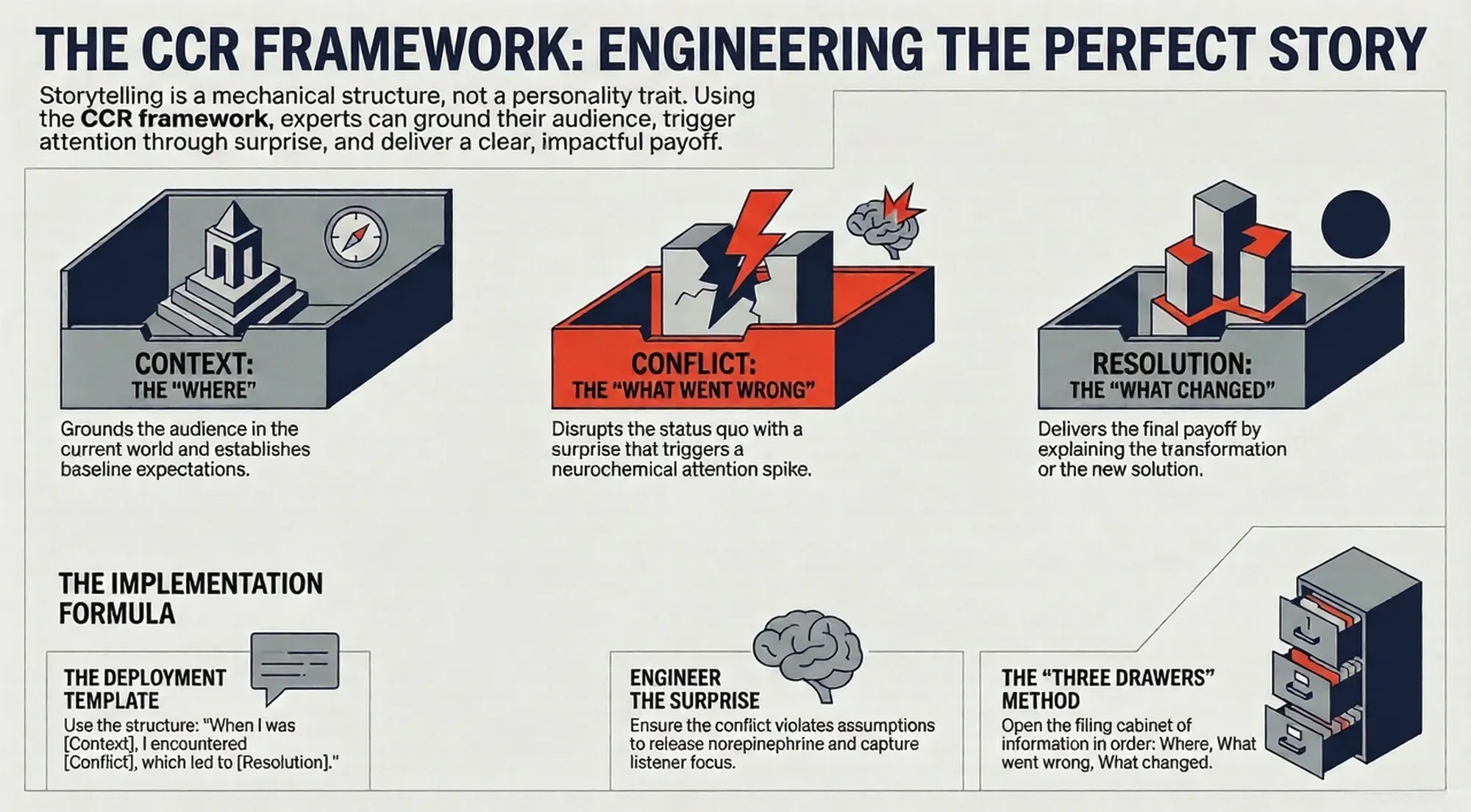
Imagine you have a filing cabinet with three drawers. The top drawer is labelled “Where.” The middle drawer is labelled “What went wrong.” The bottom drawer is labelled “What changed.” Every time you need to communicate your expertise, in a pitch, a presentation, a grant proposal, a LinkedIn post, a hallway conversation, you open those three drawers in order. You don’t need to be eloquent. You don’t need dramatic flair. You need these three drawers. Not seventeen. Not a filing cabinet the size of your dissertation appendix. Just three.
The formula is this: “When I was [CONTEXT], I encountered [CONFLICT], which led to [RESOLUTION].”
Research presentation. “When I started studying early biomarkers in 2007, I assumed the diagnostic challenge was technical, that we needed better imaging tools. Three years in, I discovered the real barrier was behavioural because patients weren’t seeking testing until symptoms were already severe. That insight transformed our entire research programme toward pre-symptomatic screening protocols.”
Client pitch. “When we first audited your onboarding flow, we expected to find a design problem. What we found instead was a trust problem because new users didn’t believe the product could do what the marketing promised. That’s why our recommendations focus on proof points, not interface changes.”
Team update. “When we launched the beta last quarter, we assumed our biggest risk was server load. The actual bottleneck was customer support. We’d underestimated ticket volume by 300 percent. We’ve since restructured the support pipeline, and average response time is down from 48 hours to six.”
Grant proposal. “When I began this line of inquiry, the prevailing model predicted X. Our preliminary data showed Y. This proposal seeks funding to investigate what that discrepancy means for the field.”
Job interview. “When I joined the team, retention was at 68 percent and declining. I identified that the root cause wasn’t compensation. It was a disconnect between new hires’ expectations and their first-90-days experience. After redesigning the onboarding process, retention climbed to 89 percent within two quarters.”
Notice what each of these does. The context grounds the listener. The conflict creates tension, a rift between expectation and reality. The resolution delivers the payoff. The listener’s brain doesn’t have to work to follow the logic, because the structure is doing the work for them. This is one of the core reasons why stories feel effortless to absorb even when the underlying ideas are complex.
The other thing to notice here is that the conflict is always a surprise. The researcher expected a technical problem and found a behavioural one. The UX team expected a design flaw and discovered a trust deficit. The beta launch team predicted server strain and got buried by support tickets. The conflict works precisely because it violates the listener’s assumption. That violation creates a small spike of neurochemical attention, a burst of norepinephrine that the brain interprets as that it needs to pay attention because something unexpected is happening. Surprise spikes attention. Engineer it.
The one thing they’ll remember
Here’s a test. Think about the last conference talk you attended, and I mean the one you actually remember. Not the one with the best slides. The one that stuck with you. I’d wager you can recall one idea from it. Maybe two. A single image. A single line. A single moment where the speaker said something that made you think, “I need to write that down.”
The sketchnote artist Katrin Wietek captures this principle with a deceptively simple phrase: Audiences remember one thing. Your job is to decide what that one thing is.
Most experts resist this brilliant idea. After years of accumulating knowledge, the instinct is to share as much of it as possible. You’ve done the work. You’ve earned the depth. Leaving things out feels like a waste, or worse, an oversimplification. More slides. More static.
In 2006, Hans Rosling walked onto the TED stage with decades of UN health data and one animated chart. This was a talk I would remember for years.
Rosling was a professor of global health at Sweden’s Karolinska Institutet. He had spent years teaching students about global development and discovered something unsettling. His students at one of Europe’s top medical schools knew less about the developing world than chance alone would predict. They had access to the same UN statistics he did. The data didn’t stick. The numbers didn’t move them.
For his TED talk, he chose an animated chart built with his Gapminder software, showing 200 countries tracked across four decades, life expectancy on one axis, income on the other. As he narrated, the bubbles moved. Countries converged. The world visibly improved in real time, right in front of the audience. It was impressive.
He could have shown tables. Reports. Statistical summaries. He chose one thing. Flowing data.
The talk has been watched over four million times. Within a year, Google acquired the Gapminder visualization software and made it freely available worldwide. The data hadn’t changed. The same UN statistics had existed for years, and for years they had sat in databases while the world operated on assumptions Rosling could prove were wrong. What changed was the decision to show one idea, one image, one thing in motion, and trust that a single animated chart could do what decades of reports had not. You can do similar magic with any data you have using Claude Code today with just a few simple prompts.
The discipline is the same whether you’re a global health professor or a data scientist presenting to a board. Cutting the other eleven findings feels like betraying the work. But the work only lands if someone receives it. The sacrifice isn’t the data. The sacrifice is the ego that wants credit for all of it at once. Suppress it.
Make one point. Get heard. It means doing the hard cognitive labour of deciding which single insight matters most, and then building everything else around it.
I didn’t know it at the time, but this principle would reshape how I approached every piece of communication I produced, from keynote talks to grant applications to the emails I sent to collaborators. The constraint of one idea is not a limitation. It’s an act of generosity toward your audience. You’re not withholding. You’re curating. You’re basically saying: “I’ve done the work of sifting through complexity so you don’t have to, my friend.”
Think about the experts you admire most. The ones whose ideas have actually changed how you work or think. I’d bet they’re known for one thing each. Not because their knowledge is narrow, but because they had the discipline to lead with a single, great idea and let everything else orbit around it. Brené Brown: Vulnerability. Daniel Kahneman: Cognitive bias. Clayton Christensen: Disruption. Katalin Karikó (finally, after decades in obscurity): mRNA. Each of them knew a hundred things. They chose to be known for one. Meanwhile, your LinkedIn headline lists nine specialties, three certifications, and a partridge in a pear tree. Pick one. Let the rest orbit.
Your expertise doesn’t speak for itself. It never did. Katalin Karikó had the right answer for 30 years. Nobody heard her until someone wrapped it in a story. That’s the same game you’re playing.
Go package your expertise into a story people can feel. I’m rooting for you.
Bonus
The Write Insight subscribers with an AI Research Stack premium account this week also get 2 print-ready PDF worksheets (a one-page Expert Story Builder Card and a multi-page Expert Visibility Worksheet), 3 AI prompts (audit any presentation or paper for story vs. data balance, convert your expertise into a Context/Conflict/Resolution narrative, and extract the one thing from a complex document), 5 curated resources on expert storytelling and science communication, and a full 5-phase Expert Story Conversion Protocol checklist.


